
A bottle that attaches to your garden hose, costs a fraction of a machine rental, and claims to do the job of a 200-pound core aerator. That’s the pitch.
A liquid lawn aerator is a spray-on product, usually a wetting agent or soil conditioner, sold to loosen compacted soil without machinery. It may help water soak in a little better. No solid evidence shows it can replace mechanical core aeration on lawns that are truly compacted.
The short version: Liquid aeration is a mild soil treatment, not aeration in the physical sense. Compacted lawns need holes pulled out of them, and a liquid can’t do that. For healthy lawns with a thatch or water-repellency issue, a liquid product may be a cheap extra.
What most people get wrong:
- “Aeration” on the label doesn’t mean air is being added. The product changes how water behaves in soil, and soil structure stays largely as it was.
- Most product claims come from the manufacturer. Independent university trials on consumer liquid aerators are scarce.
- A lawn that looks tired isn’t automatically compacted. Shade, shallow watering, and low nitrogen produce the same thin turf.

What is a liquid lawn aerator?
A liquid lawn aerator is a concentrated spray, applied with a hose-end sprayer or pump sprayer, that is marketed as a way to loosen soil and improve drainage. The active ingredients differ by brand. Common ones include surfactants (soap-like compounds that lower water’s surface tension), humic or fulvic acids, seaweed extract, yucca extract, and sometimes gypsum.
That ingredient variety matters. “Liquid aerator” is a marketing category, not a defined product type, so two bottles can contain very different things. Read the label’s ingredient list before buying, not the front panel.
Brand claims usually center on three results: looser soil, deeper roots, and less need for a core aerator. The second and third are the shaky ones.
How is a liquid lawn aerator supposed to work?
A liquid lawn aerator is supposed to work by chemistry rather than mechanics. Surfactants help water spread and penetrate instead of beading on the surface. Humic acids are said to improve how soil particles clump. Gypsum, where used, can change how clay particles bind together. Each mechanism is real in specific conditions, but none removes soil.
Take gypsum. It can improve structure in sodic soils, which carry high sodium levels, a problem more typical of arid regions and areas irrigated with salty water. On ordinary clay that isn’t sodic, extension guidance generally says gypsum does little to loosen compaction. A bottle containing gypsum is not a bottle that fixes your clay.
Wetting agents have the clearest track record, but for a different problem. Turf managers use them on hydrophobic (water-repellent) soil, where dry patches shed water like a waxed car. That is a water-behavior issue. Compaction is a space issue, with soil particles pressed together so tightly there’s little pore space for air and water.
Does a liquid lawn aerator work?
A liquid lawn aerator works in a narrow sense: some ingredients, especially surfactants, can improve water infiltration on dry or water-repellent soil. It does not reliably relieve physical compaction, and independent evidence that it substitutes for core aeration is thin. The honest answer is “sometimes, for a different problem than the label implies.”
Here’s the part that’s genuinely contested: whether humic acids and similar biostimulants produce a measurable lawn benefit at the low rates in consumer products. Research results are mixed and depend on soil, rate, and product. That’s the one uncertainty here, and the rest of this section stands without it.
Core aeration has the better-documented mechanism. A core aerator pulls out plugs of soil, commonly about half an inch to three-quarters of an inch wide and two to three inches deep. Those holes physically relieve pressure and give roots and water a path. A liquid can’t remove a plug.
My position: if your lawn is compacted, skip the liquid and rent or hire a core aerator. If your lawn is healthy and you’re curious, a liquid product is a low-risk experiment, but don’t expect a transformation.
Liquid aeration vs core aeration: how do they compare?
Liquid aeration and core aeration are different tools for different problems. Core aeration physically removes soil plugs to relieve compaction, while liquid aeration applies chemistry to change how water and soil particles behave. The table shows where each one fits.
| Liquid aerator | Core aerator | |
|---|---|---|
| How it works | Surfactants, humic acid, or gypsum in solution | Removes soil plugs |
| Fixes compaction | Not reliably | Yes |
| Helps water-repellent soil | Often, if it contains a wetting agent | Partly |
| Effort | Hose-end or pump sprayer | Machine rental or hired service |
| Independent evidence | Limited | Strong |
| Best for | Dry patches, light maintenance | Heavy foot traffic, clay, new-build lawns |
New-build lawns are a classic compaction case. Heavy equipment squeezes the topsoil during construction, and builders often leave a thin layer of fill over hard subsoil. Those lawns respond poorly to anything poured on the surface.
When is a liquid lawn aerator worth buying?
A liquid lawn aerator is worth buying only when your problem is water behavior rather than soil density. Dry spots that repel water, hose runoff that pools on the surface, and mild maintenance on already healthy turf are reasonable uses. Compacted, hard-packed soil is not.
Use this as a decision rule:
- If the soil is rock-hard after rain and a screwdriver won’t push in more than an inch or two, then core aerate. Skip the liquid.
- If water beads and runs off dry patches but the soil underneath is loose, then a wetting agent may help.
- If your lawn is sandy, then neither is a priority. Sandy soils rarely compact.
- If you have heavy clay and kids or pets running across it daily, then plan on core aeration every year or two.
- If the lawn is thin but the soil is soft, then look at mowing height, watering depth, and fertilizer before buying anything.
Timing matters for core aeration. Cool-season grasses such as fescue and bluegrass do best aerated in early fall or spring. Warm-season grasses such as Bermuda and zoysia do best in late spring through early summer, when they’re growing actively .


How do you check whether your lawn is actually compacted?
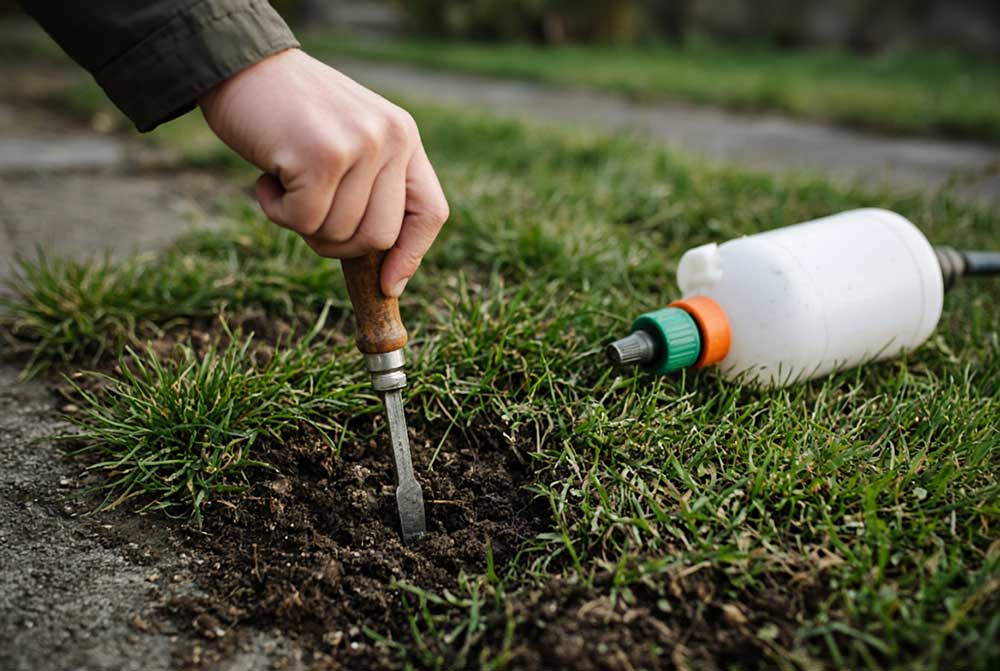
You can check lawn compaction with a screwdriver or a garden fork. Push either into the soil a day or two after rain or deep watering. If the tool goes in easily to three or four inches, compaction is unlikely. If it stalls near the surface or you need real force, the soil is dense and core aeration is the better fix.
Two more cheap signals. Water that puddles on the lawn long after a rainstorm points to poor infiltration. Grass that browns at the edges of footpaths while the rest stays green points to traffic damage. Both are far more useful than a bottle’s front label.
Test in several spots. Compaction is rarely uniform. The strip beside a driveway or the shortcut your family takes to the shed can be rock-hard while the back corner is fine.
How do you use a liquid lawn aerator if you want to try one?
Using a liquid lawn aerator is simple: dilute it according to the label, spray it evenly over the lawn with a hose-end or pump sprayer, then water it in. Rates and timing vary by product, so the label governs. Most manufacturers suggest applying during active growth rather than drought or dormancy.
A few mistakes come up repeatedly. Overapplying doesn’t speed anything up, and some surfactants can cause problems at high rates. Applying onto bone-dry, baked soil without pre-watering wastes product because the liquid runs off. And stacking products, a liquid aerator plus fertilizer plus weed control in one pass, makes it impossible to tell which one did what.
Keep a note of the date, the product, and what the lawn looked like. If you’re going to judge a product, you need a before picture.
Frequently asked questions
Can a liquid lawn aerator replace core aeration?
Not reliably. Core aeration physically removes soil plugs to relieve compaction, and a spray can’t do that. Liquid products may help with water penetration, but independent proof that they fix compacted soil is limited. For hard, dense soil, core aeration remains the better-supported choice.
How long does a liquid lawn aerator take to work?
Manufacturers often claim visible results within a few weeks, though that timing comes from product marketing. A wetting agent can improve water penetration within days on water-repellent soil. Any structural change to clay, if it happens, would take much longer.
Is a liquid lawn aerator safe for pets and kids?
It varies by ingredients, so read the safety section of the label. Many products advise keeping people and pets off until the spray dries. Don’t rely on “natural” on the front panel as a safety guarantee.
How often should you aerate a lawn?
Lawns on heavy clay or with heavy traffic often benefit from core aeration once a year. Lawns on loose or sandy soil may need it far less often, or never. Test the soil with a screwdriver first and let the result decide the schedule.
Is a liquid lawn aerator worth the money?
Only for the right problem. If you have water-repellent patches, a wetting-agent product is a cheap option. If your soil is truly compacted, the money is better spent on a core aerator rental, where the cost buys a mechanism that is well documented.
Sources
- University extension services (turfgrass and lawn care publications on core aeration, compaction, and soil amendments): add specific publication titles, publishers, and years after verification.
- Product labels from manufacturers of liquid aerators (ingredient lists and application rates), cited by brand and label date.
