
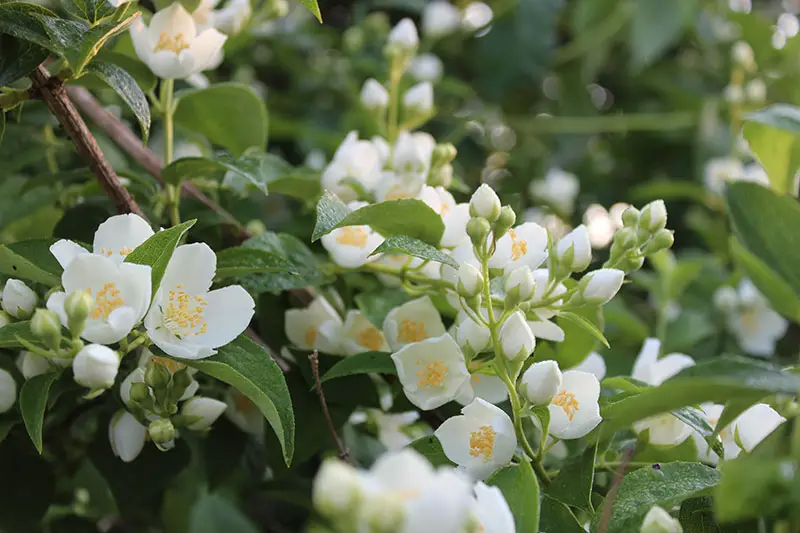
Most jasmine plants don’t die from neglect. They die from love — specifically, too much water poured on out of guilt because the leaves looked a little droopy one afternoon.
That’s the pattern with jasmine. It’s a forgiving plant in almost every way except one: soggy roots. Get that part right and the rest is mostly patience.
What Jasmine Actually Needs
Jasmine wants bright light, a pot that drains fast, and a dry stretch between waterings. That’s the short version. The plant is native to warm regions of Asia, the Middle East, and parts of Africa, and it grows like a vine that wants to climb or trail — not sit primly in a pot like a succulent.
Common jasmine (Jasminum officinale) and Arabian jasmine (Jasminum sambac) are the two most sold as houseplants or patio plants, and their care is nearly identical. If you bought a “jasmine” from a nursery without a species tag, treat it the same way. Star jasmine (Trachelospermum jasminoides) isn’t a true jasmine at all — it’s in a different family — but it tolerates the same routine, so nobody’s going to mess up by following this guide for it.
Light: More Than You Think
Give it four to six hours of direct sun, or bright indirect light all day if direct sun isn’t available. A south- or west-facing window works indoors. Outdoors, morning sun with afternoon shade in hot climates keeps the leaves from scorching.
Low light is the quiet killer of jasmine blooms. The plant will survive in a dim corner — leaves stay green, vine keeps growing — but it won’t flower. No flowers is the single most common complaint jasmine owners have, and nine times out of ten the fix is: move it closer to a window, or outside.
Watering: The Part People Get Wrong
Water when the top inch or two of soil is dry. Stick a finger in. If it’s dry, water thoroughly until it runs out the drainage holes. If it’s still damp, wait.
Jasmine roots rot in wet soil faster than most houseplants. Yellowing leaves that drop suddenly, a sour smell from the pot, black or mushy roots if you tip it out — that’s overwatering, not underwatering, even though the symptoms look similar to thirst. The instinct when leaves droop is to water more. Resist it. Check the soil first.
In summer, that might mean watering every 3-5 days. In winter, it could stretch to once every 10-14 days, since the plant slows down and uses less. There’s no fixed schedule that works everywhere — soil type, pot material, humidity, and temperature all shift the timing. Terracotta pots dry out faster than plastic. A sunroom dries soil faster than a shaded porch.
Soil and Pot
Use a well-draining potting mix — a standard indoor potting soil with some perlite or coarse sand mixed in works fine. Straight garden soil compacts and holds too much water.
The pot needs a drainage hole. Not optional. Without one, even careful watering eventually drowns the roots because there’s nowhere for excess water to go.
Humidity and Temperature
Jasmine likes humidity around 40-50% and temperatures between 65-75°F (18-24°C) during the day, with a slight nighttime drop. Dry indoor air in winter — from heating systems — can cause crispy leaf edges. A pebble tray under the pot or an occasional misting helps, though neither is dramatic enough to fix a plant that’s already struggling from other causes.
Jasmine actually wants a cooler period to trigger blooming. Many varieties need several weeks below 65°F (18°C) — but above freezing — in fall to set flower buds for the following season. This is the part most casual growers skip entirely. If a jasmine never blooms despite good light and water, and it’s been kept in a consistently warm house all year, that missing cool period is often the reason.
Feeding
Feed every 4-6 weeks during spring and summer with a balanced liquid fertilizer, diluted to half strength. Skip fertilizing in fall and winter — the plant isn’t actively growing then, and feeding a dormant plant does nothing useful and can build up salts in the soil.
Too much nitrogen specifically pushes leafy growth at the expense of flowers. If a jasmine is lush and green but never blooms, and it’s getting plenty of light, over-fertilizing (or a fertilizer too high in nitrogen) is worth checking.
Pruning
Prune after flowering, not before. Jasmine typically blooms on new growth, so cutting it back right after the bloom cycle ends gives it the whole next growing season to produce fresh stems and buds.
Cut back by about a third to keep it bushy rather than leggy and vine-y. Jasmine left unpruned for a few years turns into a tangle of bare stems with flowers only at the very tips — technically alive, not particularly attractive. Regular pruning also controls size, since left alone, vining types can grow 10-15 feet in a season under good conditions.
Common Problems, Plainly
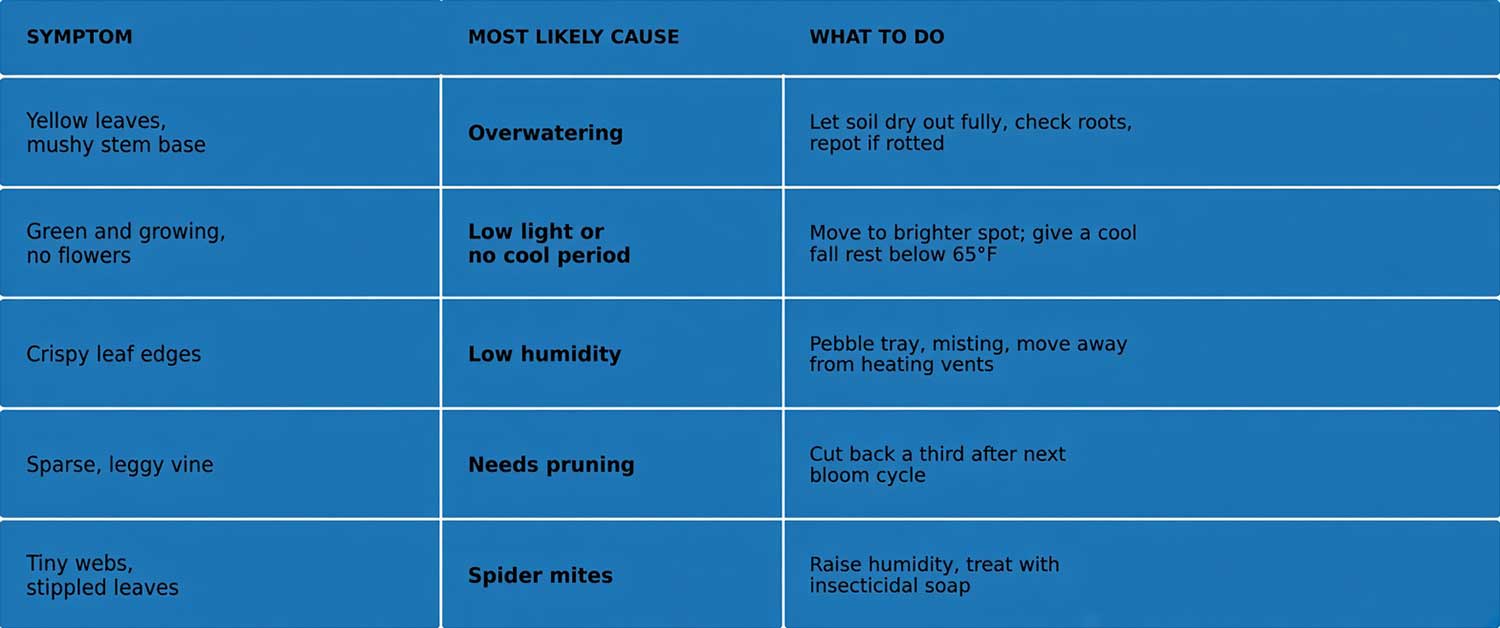
- Leaves turning yellow and dropping: almost always overwatering. Check root health before doing anything else.
- No flowers despite healthy leaves: insufficient light, no cool dormant period, or too much nitrogen fertilizer. Address light first — it’s the most common cause.
- Leaves crispy and brown at the edges: low humidity, especially indoors in winter with heating running.
- Spider mites or webbing on the underside of leaves: dry indoor air again, this time inviting pests. Increase humidity and wipe leaves down or use insecticidal soap.
- Leggy, sparse growth: needs pruning and more light. Usually both together.
A Quick Decision Guide
Indoor vs. Outdoor: Which Fits Your Setup
Outdoor growing in a warm climate (roughly USDA zones 7-10, depending on species) gives jasmine the light and temperature swings it wants naturally, with less fuss. Indoor growing works fine but demands more attention to light placement and that cooler autumn rest — otherwise flowering suffers.
If space and climate allow, a pot that spends summer outside and comes in only before frost tends to bloom better than one kept indoors year-round.
The Long View
Jasmine isn’t a plant that needs constant fussing. It needs the basics done consistently — enough light, dry spells between watering, a pot that drains, a pruning after each bloom — and it rewards that consistency with flowers that smell disproportionately good for how little effort went in.
The plants that struggle are almost never neglected. They’re overwatered, under-lit, or never given the cool snap they need to bloom. Fix those three things, in that order, and most jasmine problems solve themselves.
