
Most people who kill a Manjula pothos never see it coming. They’re used to golden pothos—that forgiving, practically unkillable vine that thrives on neglect. So they bring home a Manjula, treat it the same way, and two months later they’re staring at a pot of yellow, crispy disappointment.
Here’s the uncomfortable truth: Manjula (Epipremnum aureum ‘Manjula’) looks like a pothos. It grows like a pothos. But its care sits in a slightly different universe—one governed by the rules of heavy variegation. Once you understand why that matters, you’ll never accidentally kill one again.
Manjula pothos needs bright indirect light (non-negotiable), slightly less frequent watering than its solid-green cousins, and consistently warm temperatures. It’s not difficult, but it’s also not as bulletproof as standard pothos.
What most people overlook:
- Those creamy white and silver patches aren’t just decorative—they’re zones with zero chlorophyll, which changes the plant’s entire relationship with light
- Overwatering is the #1 killer, but it’s often masked as a light problem because both produce yellowing leaves
- Leaf shape variation (some almost entirely white, others mostly green) is completely normal and actually a sign of healthy genetics—not disease or stress
What Even Is a Manjula Pothos?
Let’s start somewhere surprisingly few care guides go: why this plant exists at all.
Manjula is a patented cultivar, developed and introduced by the University of Florida. That’s not trivia—it matters for sourcing. Because it’s protected by a plant patent, every legitimate Manjula you buy was propagated under license, which actually means quality control is relatively consistent. Unlike some houseplants that arrive mislabeled or hybridized beyond recognition, a properly labeled Manjula is almost always the real thing.
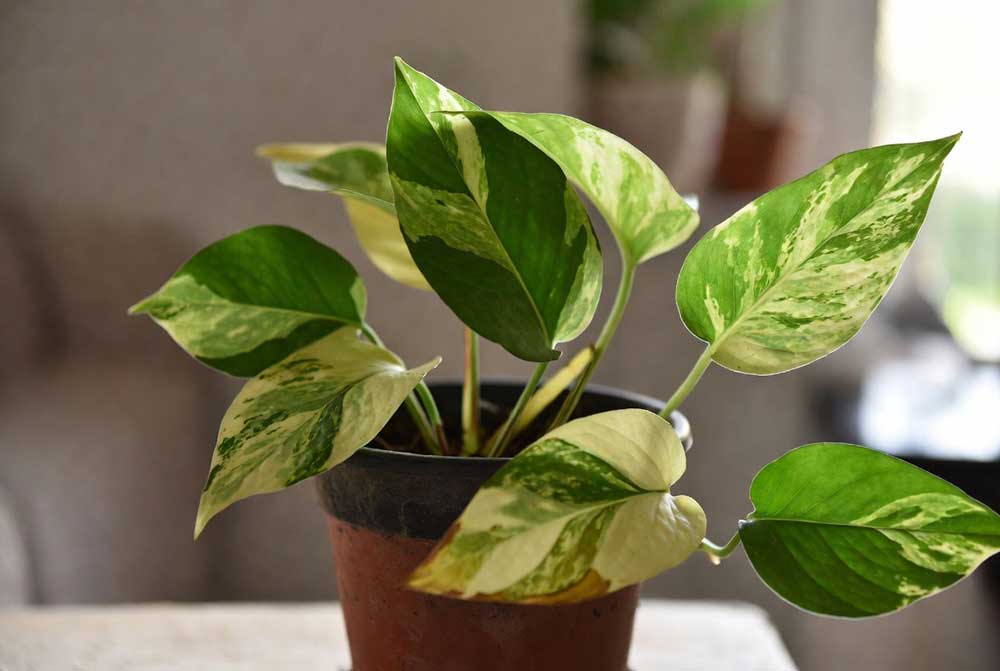
What makes it visually unmistakable is the variegation pattern. Unlike marble queen, which has relatively predictable streaky marbling, Manjula leaves are wildly unpredictable—you’ll see splotches, swirls, and zones of pure white or silver alongside deep green, all on the same plant and sometimes the same leaf. The edges tend to stay greener while the centers can bleach out almost completely. No two leaves are exactly alike, and that chaotic beauty is precisely the point.
The leaf shape is also distinct: broader and slightly heart-shaped with gently ruffled or wavy edges, different from the flatter, more pointed leaves of golden or marble queen pothos. It tends to grow more compact and slightly less vigorously than its relatives—a direct consequence of those white patches doing no photosynthetic work.
Light: Where Most People Go Wrong First
Variegated plants need more light than their solid-green counterparts. This isn’t a preference—it’s physics.
Every white or pale area on a Manjula leaf contains no chlorophyll. That section of the plant cannot photosynthesize at all. So the remaining green portions have to work harder to produce enough energy to sustain the whole plant. Give a Manjula too little light and you’re essentially starving it, even when the green sections look fine for a while.
In practice, bright indirect light means sitting within 2–4 feet of a window that receives several hours of natural light per day. An east-facing window is nearly ideal—gentle morning sun, bright indirect for the rest of the day. North-facing windows are almost always insufficient unless you supplement with a grow light. West and south-facing windows work well but keep the plant back from the glass if direct afternoon sun blazes through, because those white leaf sections will scorch in a way that green leaves might tolerate.
The sneaky failure pattern: people move the plant to a “bright” spot that’s really just “not dark.” They see new growth, feel reassured, then gradually notice the plant is producing leaves with less and less white—more green, smaller, less dramatic. The plant is actually reverting toward more green to compensate for insufficient light. It’s surviving, not thriving.
If you’re seeing mostly green new growth on a plant that had beautiful variegation when you bought it, add more light before anything else. Grow lights work exceptionally well for Manjula—a full-spectrum LED positioned 6–12 inches above the canopy for 12–14 hours daily can replicate ideal conditions in even the darkest apartment.
One counterintuitive thing worth knowing: Manjula can occasionally produce a leaf that is almost entirely white—called a “sport” or hypervariegate growth. These leaves are spectacular but functionally useless to the plant. If a stem starts producing several nearly-white leaves in a row, you can leave them (they look incredible) but the plant will eventually compensate by pushing out greener growth elsewhere. Don’t worry about it.
Watering: The Nuance Most Care Guides Flatten
The standard advice is “let the top inch of soil dry out.” That’s fine as far as it goes, but it misses the most important variable: your specific soil, pot, and environment.
Manjula, like all heavily variegated pothos, grows slightly slower than a solid green plant. Slower growth means slower water uptake. Combine that with the general pothos recommendation of “don’t overwater” and you get a plant that needs even more restraint than you’d expect.
The actual reliable method: stick your finger 2 inches into the soil. If it still feels damp, wait. Water thoroughly when the top 2 inches are dry—not bone dry all the way through, but clearly dry at that depth. In a well-draining mix in a terracotta pot, this might be every 10–14 days in winter and every 7–10 days in summer. In plastic pots with standard potting mix, add several more days to those estimates.
What makes overwatering particularly tricky is that it doesn’t look like drowning—it looks like nutrient deficiency. Yellow leaves, starting from the lower oldest growth, combined with soft, slightly mushy stems near the soil line. By the time root rot is visually obvious, you’re already in triage mode.
The fix when you suspect overwatering: stop watering entirely, move the plant somewhere with better airflow, and don’t fertilize (fertilizing stressed roots causes chemical burn). Let the soil get genuinely dry, then assess. If leaves keep yellowing even after the soil dried, unpot and inspect the roots—healthy roots are firm and light-colored, rotten roots are brown, slimy, and smell unpleasant.
Underwatering looks different: the entire plant wilts, leaves go limp and then crispy from the tips inward, and the soil pulls away from the pot edges. Manjula recovers from underwatering better than overwatering—a thorough watering usually perks it up within 24 hours.
Soil and Potting: The Foundation That Determines Everything Else
Standard houseplant potting mix straight from the bag is too dense for Manjula to thrive long-term. It holds moisture well initially, which sounds good, but as it ages it compacts, reduces airflow to roots, and swings from soaking wet to bone dry rather than staying evenly moist.
A better mix: two parts standard potting mix, one part perlite, one part orchid bark. This keeps the soil aerated, drains quickly after watering, and allows roots to breathe between waterings. If you can only amend one way, adding 25–30% perlite by volume to any standard mix gets you most of the way there.
Pot choice matters more than most people realize. Terracotta’s porosity actively helps regulate moisture by allowing some evaporation through the walls—great for anyone who tends to overwater or lives in a humid climate. Plastic and glazed ceramic retain moisture longer—better for those who forget to water or live somewhere very dry and warm.
Pot sizing: always pot up just one size at a time. A Manjula in a pot that’s too large relative to its root mass will sit in soggy soil for weeks because the roots can’t drink water fast enough before it stagnates. This is one of the most common root rot triggers and one of the most avoidable.
Temperature, Humidity, and Why You Probably Don’t Need to Stress
Manjula is a tropical plant, so it prefers temperatures between 65°F and 85°F (18°C to 29°C). It’ll tolerate down to about 60°F (15°C) but growth will slow noticeably. Anything below 55°F (13°C) causes real damage—cold drafts from winter windows can cause blackened, mushy patches on leaves surprisingly quickly.
The practical upshot for most people: keep it away from drafty windows in winter, away from AC vents that blast cold air directly, and it’ll be fine in virtually any normal home environment.
Humidity is where care guides get unnecessarily complicated. Manjula will grow fine in average household humidity (40–60%). It doesn’t need a humidifier, a pebble tray, or daily misting. If you live somewhere genuinely arid and notice consistent brown crispy leaf tips (not to be confused with the yellowing from overwatering), then boosting humidity helps—but it’s rarely necessary in most indoor environments.
Misting is a contentious practice. It temporarily raises humidity for about 20 minutes, after which conditions normalize. More meaningfully, water sitting on leaves in low-airflow environments creates ideal conditions for fungal issues. If you want to mist, do it in the morning so leaves dry completely during the day.
Fertilizing: Less Is Genuinely More
Because Manjula grows slower than non-variegated pothos, its nutrient needs are proportionally lower. Overfertilizing is a surprisingly common problem—fertilizer salts accumulate in the soil, chemically burn roots, and create the same yellowing symptoms as overwatering.
A balanced liquid fertilizer at half the recommended dose, applied monthly during spring and summer, is completely sufficient. Skip fertilizing entirely in fall and winter when growth naturally slows. If you notice white crusty deposits forming on the soil surface or pot rim, flush the soil thoroughly with plain water to clear accumulated salts.
One nuance worth knowing: nitrogen-heavy fertilizers promote vigorous green growth, which sounds desirable but can actually reduce variegation in already-green-heavy plants. A balanced NPK (like 10-10-10 or 20-20-20) keeps the plant healthy without pushing it toward reversion.
Propagation: Where Manjula Gets Interesting
Propagating Manjula is straightforward in method but has one important consideration most guides skim over: the plant patent.
Technically, propagating a patented plant for personal, non-commercial use exists in a legal gray zone in many countries. Propagating to sell is clearly prohibited under the patent. Most hobbyists propagate freely for personal collections and gifting to friends, and enforcement against home growers is essentially nonexistent—but it’s worth knowing this context.
Stem cuttings in water or moist sphagnum moss work reliably. Take a cutting with at least one node (the small bump on the stem where a leaf connects), remove any leaves that would sit below the waterline, and place in a bright indirect light spot. Roots typically appear within 3–6 weeks. Once roots are 1–2 inches long, pot into the aerated mix described earlier.
When selecting cuttings for propagation, choose stems with a healthy balance of green and variegated growth. A cutting taken from a mostly-white stem will have less energy to put toward root development and may fail or produce reversion growth. A cutting from a well-balanced variegated stem tends to root faster and maintain better variegation in the resulting plant.
Common Problems and How to Actually Diagnose Them
Rather than listing symptoms, here’s how to think through what’s actually wrong:
Yellow leaves — the most common complaint, and it could be four different things:
- Overwatering (yellowing starts on older lower leaves, stems may feel soft)
- Underwatering (plant looks wilted first, then yellows, tips go brown)
- Too little light (yellowing is uniform, plant may also be producing smaller/more green leaves)
- Root bound (happens in older plants; fine roots circling the pot restrict water and nutrient uptake)
Work through these in order. Overwatering is the most common culprit by far.
Brown leaf tips — usually low humidity, fertilizer salt buildup, or inconsistent watering. Not typically a serious problem.
Pale, washed-out leaves losing color — too much direct sun bleaching the chlorophyll. Move back from the window.
Leggy, stretched growth with long gaps between leaves — not enough light. The plant is reaching toward any available source.
Leaf curl — underwatering or low humidity, usually. Water thoroughly and see if it resolves within 24 hours.
The Decision Framework: Is Manjula Right for You?
Manjula suits you well if you have a bright indoor space (near a window or with supplemental lighting), tend toward infrequent watering rather than frequent, and want a genuinely unique-looking plant that stays manageable in size. It’s a good choice for intermediate growers who’ve mastered basic pothos care and want something that requires slightly more attention to lighting.
It’s probably the wrong choice if you have predominantly low-light spaces, tend to water heavily and frequently, or want rapid, dramatic growth. A marble queen pothos would give you similar variegation drama with less fussiness, while a golden pothos handles low light and irregular watering far more graciously.
| Condition | Manjula Handles It | Better Alternative |
|---|---|---|
| Low light | Poorly | Golden or neon pothos |
| Frequent watering | Poorly | Peace lily |
| Dry air (under 30% humidity) | Adequately | N/A (common in most homes) |
| Bright indirect light | Thrives | — |
| Occasional forgetting to water | Well | — |
| Beginner grower | Challenging | Golden pothos |
The Bigger Picture
Manjula pothos sits at a fascinating intersection: it carries the easygoing genetics of one of the most forgiving houseplant families, but its heavy variegation means it operates by slightly stricter rules. Get the light right and don’t drown it, and Manjula is actually quite low-maintenance. Push it into low light or wet soil, and that forgiving reputation evaporates fast.
The growers who do best with it tend to be the ones who understand why the rules exist—not just what they are. A Manjula in bright indirect light that dries between waterings isn’t just surviving because you followed a care guide. It’s thriving because the conditions genuinely mimic what this plant’s physiology evolved to need.
That’s the real care secret, honestly. Not a specific watering schedule or humidity percentage—just understanding that those patches of white on every leaf are the plant constantly betting everything on the green parts getting enough light. Give it that, and Manjula will reward you with some of the most spectacular, conversation-starting foliage in the entire pothos family.
Care insight basis: Analysis of documented grower experiences across plant communities, university extension horticultural guidelines, and published research on variegated Epipremnum cultivar physiology. The plant patent context references University of Florida IFAS documentation. Soil mix recommendations reflect common practices in the broader aroid-growing community validated across diverse home growing environments.
