
Walk into any garden center, scroll through any gardening Facebook group, or ask your neighbor with the suspiciously lush tomatoes for advice, and you’ll hear the same thing: “Have you tried Epsom salt?” It gets recommended for yellowing leaves, reluctant bloomers, leggy peppers, sad roses—you name it. It’s the duct tape of the garden world.
Well, for most of those problems, it doesn’t work. In many cases, it makes things worse.
That might feel like a betrayal. Epsom salt is inexpensive, widely available, and has a devoted fanbase that includes grandmothers, master gardeners, and YouTube channels with millions of subscribers. So where did this belief come from, and why does it persist so stubbornly even as the science quietly, politely, keeps saying “actually, no”?
Epsom salt (magnesium sulfate) is a real mineral compound. Magnesium and sulfur are real plant nutrients. But most garden soil already has enough of both—and adding more without testing first can actively harm your plants and soil biology.
What most people miss:
- The symptoms Epsom salt is supposed to fix are almost never caused by magnesium deficiency in typical home gardens
- Excess magnesium competes with calcium uptake, contributing to blossom end rot in tomatoes and peppers
- The “Epsom salt success story” pattern is often post hoc—plants recover on their own, and the salt gets the credit
What Epsom Salt Actually Is
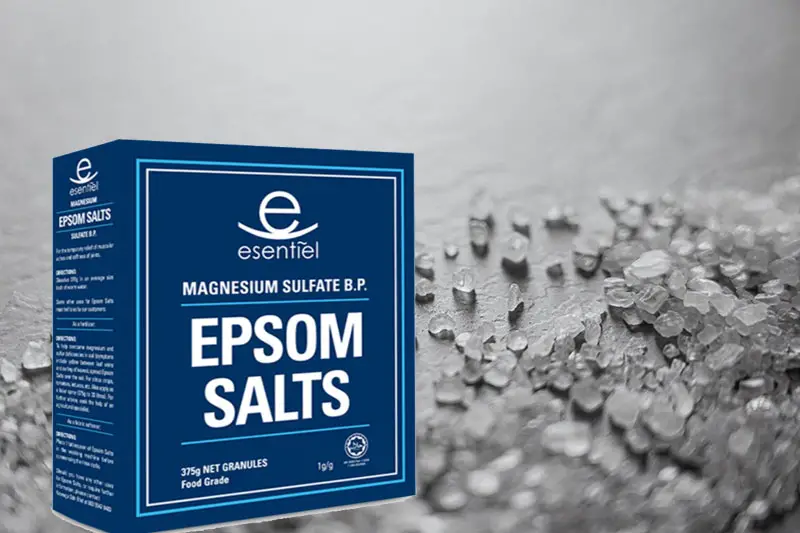
Magnesium sulfate. That’s it. The “Epsom” refers to Epsom, Surrey, England, where it was first distilled from natural spring water in the early 17th century. It’s a salt in the chemical sense—a compound formed from an acid and a base—and when dissolved in water, it releases magnesium (Mg²⁺) and sulfate (SO₄²⁻) ions.
Both magnesium and sulfur are genuine plant nutrients. Magnesium sits at the center of every chlorophyll molecule, which is why a true magnesium deficiency shows up as interveinal chlorosis—leaves yellowing between the veins while the veins themselves stay green. Sulfur plays a role in amino acid and protein synthesis.
Here’s the nuance that most Epsom salt advocates skip: being a real nutrient doesn’t mean adding more of it helps. Water is a real nutrient too, and we know what overwatering does.
In practice, magnesium deficiency in garden soil is genuinely rare outside of a few specific conditions: heavily leached sandy soils, very acidic soils where magnesium gets displaced, or soils that have been intensively cultivated for years without amendment. The average backyard vegetable bed? Almost certainly fine on the magnesium front.
The Origins of the Myth
This is where it gets genuinely interesting, and a bit of armchair anthropology helps.
Epsom salt has been used in agriculture for centuries—legitimately so in some contexts. Commercial rose growers in the UK and a handful of other industries did use it in specific, tested scenarios with documented deficiencies. Somewhere along the way, those professional applications became gardening folklore, stripped of their context.
The advice propagated through word of mouth in an era before soil testing was accessible or common. If Aunt Margaret swore by it for her roses and her roses looked great, the logical conclusion was obvious—even if the actual explanation was her careful deadheading, well-draining soil, and consistent watering schedule.
Then came the internet, and the advice was no longer just local. It became canonical.
The result is what researchers call “horticultural mythology”—practices that persist not because they’re supported by evidence, but because they’re simple, cheap, and carry the weight of received wisdom. Epsom salt hits every note: affordable, non-toxic to touch, and emotionally satisfying to apply. You’re doing something.
When Epsom Salt Is Actually Justified
Let’s be fair here, because the story isn’t purely “never use it.”
There are scenarios where Epsom salt application makes agronomic sense:
Confirmed magnesium deficiency via soil test. If you test your soil and it comes back low in magnesium—specifically, if the magnesium-to-calcium ratio is out of balance—Epsom salt is a reasonable, fast-acting correction. The key phrase is “confirmed via soil test.” Not “my leaves look yellow and I found a Reddit thread.
Intensively managed sandy soils. Light, fast-draining soils in high-rainfall areas can genuinely lose magnesium over time. Market gardeners and commercial growers operating on these soils sometimes supplement strategically.
Container plants with extended growing seasons. Containers leach nutrients with every watering. Long-season crops like peppers and tomatoes grown in pots can exhaust soil magnesium faster than ground-grown counterparts. A very light, occasional application (emphasis on occasional) isn’t unreasonable here—but it still comes second to a balanced fertilizer with complete nutrition.
Certain hydroponic and nutrient solution applications. In controlled hydroponic systems where growers are precisely managing every nutrient input, magnesium sulfate is a standard component. This is where the commercial science is solid. Your raised bed is not a hydroponic system.
The Real Cost of Getting This Wrong
Here’s the part that makes the myth actively problematic rather than just harmlessly ineffective.
Excess magnesium in soil displaces calcium. They compete for the same uptake sites in plant roots. Calcium is critical for cell wall integrity—and in tomatoes and peppers, insufficient calcium uptake is the primary cause of blossom end rot, that dark, leathery rot that appears at the base of fruits.
The irony is thick: many gardeners who sprinkle Epsom salt on their tomatoes to make them “healthier” are contributing to the exact nutrient imbalance that causes one of the most common and frustrating tomato problems. They then notice the blossom end rot, Google it, find that “calcium deficiency causes blossom end rot,” buy calcium spray, and never connect the dots back to the Epsom salt.
Beyond the calcium-magnesium antagonism, routine Epsom salt application without deficiency also contributes to salt accumulation in soil. Elevated soil salinity stresses plant roots, disrupts the osmotic balance that allows water uptake, and can harm the beneficial microbial communities that make soil actually work. Fungi, bacteria, nematodes, worms—the whole invisible ecosystem that converts organic matter into plant-available nutrients gets hit.
This is the failure pattern that’s most commonly overlooked: it’s not that Epsom salt immediately kills plants. It’s that incremental, unneeded applications degrade soil health in ways that accumulate over seasons, and the symptoms look like other problems.
What to Do Instead: A Decision Framework
When you see the symptoms most often attributed to magnesium deficiency—interveinal chlorosis, poor fruit set, weak growth—here’s a more useful diagnostic sequence:
Start with the actual problem, not the solution someone already sold you.
Yellow leaves with green veins can indicate magnesium deficiency, but they can equally indicate iron deficiency, manganese deficiency, normal leaf aging, spider mite damage, inconsistent watering, or root damage. The visual symptom is not diagnostic on its own.
Get a soil test. In most regions, your local cooperative extension service offers them for under $20. You’ll get pH, major nutrient levels, and often micronutrient profiles. This takes the guesswork out entirely. Most gardeners who test are surprised to find their soil is well-supplied with magnesium and low in something they weren’t thinking about—often pH-related nutrient lockout, or simply nitrogen.
Fix pH before adding nutrients. Soil pH between 6.0 and 7.0 makes most nutrients available to most plants. A soil that tests “low” in magnesium might actually have adequate magnesium that’s unavailable because the pH is wrong. Lime (which raises pH and adds calcium), sulfur (which lowers pH), or compost (which buffers both directions) often solves apparent deficiency symptoms without targeting the specific nutrient at all.
Use complete fertilizers thoughtfully. A balanced slow-release granular fertilizer or quality compost provides a spectrum of nutrients in proportion. This is almost always more useful than targeting a single nutrient in isolation.
The Broader Lesson: Simple Fixes for Complex Systems
Gardens are biological systems with enormous complexity. Soil is arguably the most complex material on Earth per unit volume—teeming with organisms, chemical reactions, and physical structures that interact in ways we don’t fully understand even now. The appeal of “just add X” solutions is completely understandable, but it tends to underestimate that complexity.
The most reliable gardening advice tends to be less exciting: build soil organic matter consistently, mulch to regulate moisture and temperature, choose appropriate plants for your conditions, water deeply and infrequently. None of that fits in a satisfying two-word tip.
Epsom salt isn’t poison. Used appropriately, with confirmed need, it’s a perfectly legitimate garden input. But the version that’s actually circulating—the “just use it regularly, it won’t hurt”—ignores what soil science has been telling us for years. And what it’s been telling us is this: when it comes to soil, more is rarely better. Balance is.
The next time someone tells you to reach for the Epsom salt, ask them what test they’re basing it on. The silence that follows is its own kind of answer.
Insights in this piece draw on soil science literature, cooperative extension guidance from multiple U.S. land-grant universities, and analysis of common patterns in horticultural advice forums. For specific soil amendment decisions, a soil test from your local extension service remains the most reliable starting point—no article, including this one, substitutes for knowing what your actual soil contains.
