
Most people’s first reaction to hydroponics is suspicion. It sounds clinical, industrial, a little sci-fi. Like something that happens under fluorescent lights in a warehouse, not in someone’s home or backyard. But here’s what’s quietly been happening over the last decade: some of the most flavourful, nutrient-dense, consistently productive food growing is happening in systems with zero soil involved. And the people doing it aren’t commercial operations — they’re home gardeners who got tired of fighting compacted clay, root rot, and pests.
The premise sounds almost too simple: give plant roots direct access to everything they need — water, nutrients, oxygen — and remove all the inefficiencies of soil as a middleman. Plants respond by growing faster, producing more, and in many cases, tasting better. There’s no magic here, just biology working without friction.
Hydroponics is a method of growing plants in nutrient-enriched water, without soil. It works by delivering dissolved minerals directly to plant roots in a controlled environment. But what most beginner guides skip over:
- The “soil-free” part is almost incidental — the real breakthrough is precision. You control exactly what the plant gets, when it gets it, and in what concentration. That’s not possible in soil.
- Water use in hydroponics is typically 70–90% lower than conventional growing, not because you use less water, but because you recirculate it rather than letting it drain away.
- The biggest failure point for new hydroponic growers isn’t equipment — it’s pH. A nutrient solution at the wrong pH locks out specific minerals even if they’re present in abundance. Most first-time failures trace back here.
Growing Without Soil Isn’t a Modern Invention
The first thing worth knowing: hydroponics is ancient. The Aztec chinampas — floating garden islands on Lake Texcoco — were essentially hydroponic systems. Babylon’s hanging gardens likely involved similar principles. The NASA research programmes of the 1970s and 80s that formalized modern hydroponic science were catching up to something humans had been doing intuitively for centuries.
What changed is our understanding of plant nutrition. Before the 19th century, scientists believed plants fed primarily on organic matter in soil — humus, decomposed material, the “essence” of the earth. It was a German chemist, Justus von Liebig, who demonstrated in the 1840s that plants actually feed on inorganic minerals: nitrogen, phosphorus, potassium, calcium, magnesium, and a suite of trace elements. Soil, in this framing, is just a delivery mechanism — and a fairly inefficient one.
That insight is the entire intellectual foundation of hydroponics. If you can dissolve those minerals in water at the right concentrations and deliver them directly to roots, the plant doesn’t need or miss the soil. It just grows.
The practical implication for home gardeners is significant: you’re not trying to replicate soil in a tank. You’re building something better. A system where a pH of 5.8–6.2 ensures nutrient availability, where EC (electrical conductivity) readings in the range of 1.5–2.5 mS/cm tell you whether your nutrient concentration is in the right range, and where roots get both water and oxygen simultaneously. None of that is controllable in a garden bed.
The Core Mechanics: What’s Actually Happening in a Hydroponic System
At its simplest, a hydroponic system has three jobs: hold the plant in place, deliver water and nutrients to the roots, and ensure the roots get enough oxygen. Every system — and there are six main types — is just a different engineering solution to those three requirements.
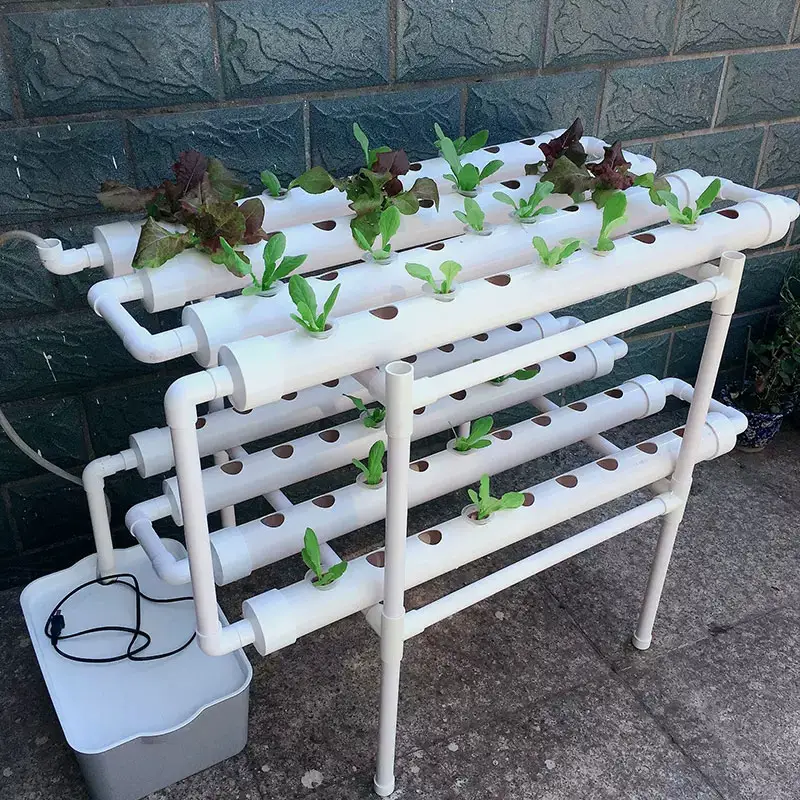
Nutrient Film Technique (NFT) runs a thin, continuous film of nutrient solution over the root zone in angled channels. The roots sit half in solution, half in air. It’s elegant, efficient, and popular for lettuce and herbs because those plants don’t need structural support. The failure mode: pump failure means the film stops within minutes, and roots dry out fast. NFT growers learn quickly to have backup pumps.
Deep Water Culture (DWC) suspends plant roots directly in a reservoir of aerated nutrient solution. An air pump keeps oxygen levels high. This is the system most beginners start with — it’s inexpensive, forgiving, and surprisingly effective. A basic DWC setup for lettuce can be built for under $50 and will outperform soil-grown lettuce in both speed and yield.
Kratky Method is DWC without the air pump — a passive, non-circulating approach where you fill a reservoir, suspend plants above it, and let the air gap above the water surface oxygenate roots as the water level drops. It sounds too simple to work well. It works extremely well for leafy greens. The catch: it’s harder to manage long-term for fruiting plants that have higher and changing nutrient demands.
Ebb and Flow (Flood and Drain) periodically floods a growing tray with nutrient solution, then drains it back to a reservoir. Roots get wet, then dry, then wet again — which turns out to be excellent for root oxygenation. Tomatoes, peppers, and strawberries do well in these systems.
Drip Systems are the most widely used in commercial operations. A timer-controlled pump delivers nutrient solution directly to individual plants via drip emitters. It’s scalable, controllable, and adaptable to almost any plant type. The complexity goes up with scale, but so does efficiency.
Aeroponics — the most technically demanding approach — suspends roots entirely in air and mists them with nutrient solution at intervals. NASA developed this for space research because it uses almost no water. Root growth in aeroponic systems is visibly faster than any other method. It’s also the most unforgiving: a clogged misting nozzle means roots begin drying within minutes.
What most explanations don’t make clear: you don’t choose a system type because it’s “better.” You choose it based on what you’re growing, how much monitoring you want to do, and what your failure tolerance is. A Kratky jar for basil on your kitchen counter is a perfectly valid hydroponic system. A multi-channel NFT setup for a serious lettuce operation is also a hydroponic system. They share the same principles; the engineering is just scaled differently.
The Nutrient Solution: Where Most of the Science Lives
Here’s where hydroponics gets genuinely fascinating, and also where most beginners get into trouble.
Plant roots in soil access nutrients through a complex ecosystem of microbial activity, root exudates, and ion exchange with soil particles. In hydroponics, you’re bypassing all of that and delivering dissolved minerals directly. This means precision is possible — and necessary.
A complete hydroponic nutrient solution needs to supply everything the plant would otherwise source from soil: the three macronutrients (nitrogen, phosphorus, potassium), the secondary nutrients (calcium, magnesium, sulfur), and micronutrients including iron, manganese, zinc, boron, molybdenum, and copper. Commercial hydroponic nutrient formulas come in two or three parts to keep calcium and phosphate separate until dilution (they precipitate if concentrated together). This is one of the non-obvious technical realities that trips up people who try to simplify their setup too aggressively.
pH is the variable that most first-time growers underestimate. The pH of your nutrient solution determines which nutrients are chemically available to plant roots, regardless of concentration. Iron, manganese, and zinc become largely unavailable above pH 6.5. Calcium and magnesium become less available below 6.0. The target range for most crops is 5.8–6.2, with some variation by species. Measuring pH at setup and adjusting with pH-up (potassium hydroxide) or pH-down (phosphoric or citric acid) solutions isn’t optional — it’s foundational. pH drift is normal as plants consume nutrients and organic matter accumulates, so checking every day or two is standard practice.
Electrical conductivity (EC) measures the total dissolved mineral concentration in your solution. Too low, and plants are nutrient-deficient. Too high, and the concentration difference between root cells and solution reverses — roots actually lose water through osmosis instead of gaining it, causing symptoms that look paradoxically like drought stress despite being submerged. Most leafy greens do well at 1.2–2.0 mS/cm. Fruiting crops like tomatoes typically want 2.0–3.5 mS/cm, higher during fruiting than vegetative growth.
Hydroponics vs. Soil: The Honest Comparison
Neither system is universally superior. The honest version of this comparison, based on what actually plays out across different growing contexts:
| Factor | Hydroponics | Soil |
|---|---|---|
| Growth speed | 30–50% faster for most crops | Standard |
| Water use | 70–90% less (recirculating) | High, much lost to drainage |
| Setup cost | Moderate to high upfront | Low |
| Learning curve | Steep initially (pH, EC, system maintenance) | Gentler, more forgiving |
| Space efficiency | High — vertical growing possible | Lower |
| Pest/disease risk | Different (fungus gnats rare; pythium and powdery mildew possible) | Full spectrum |
| Flavour | Often excellent for leafy greens; comparable for fruiting crops | Varies with soil health |
| Scalability | Excellent | Limited by land |
The crops that consistently overperform in hydroponic systems: lettuce, basil, spinach, Swiss chard, kale, cilantro, mint, strawberries, and cucumbers. The crops where the advantage is less clear: root vegetables (carrots, beets — they technically work but require specific media), large fruiting plants (tomatoes and peppers work well but demand more attention), and anything that benefits from complex soil microbiology, like certain heritage varieties.
There’s also a real conversation to have about whether hydroponics is “natural.” It’s a fair question, and the answer is honestly: it depends on your definition. The plants are real, the nutrients are either organic or mineral-derived, and the growth process is exactly the same biology as in-ground growing. What’s absent is soil as a medium. Whether that matters to you is a values question as much as a scientific one.
Getting Started Without Overthinking It
The single best advice for a new hydroponic grower: start small and simple, harvest something edible within three weeks, and let that success build your confidence before adding complexity.
A Kratky lettuce setup — a 4L opaque container, net pots, a bag of expanded clay pebbles, a two-part nutrient solution, and a pH testing kit — costs roughly $30–40 and will have you harvesting salad leaves in 21–28 days. That experience teaches you more than any guide: you’ll see roots developing, learn what healthy versus stressed plants look like, understand pH drift in practice, and develop intuition about the system that no amount of reading quite replicates.
From there, the progression makes natural sense. A small DWC system for herbs. An NFT channel for continuous lettuce production. Eventually, maybe a more ambitious ebb-and-flow system for tomatoes. Each step builds on the last.
The thing that keeps people from starting is the sense that hydroponics requires expertise before you can begin. It’s the opposite. The expertise is the beginning — and it accumulates fast because the feedback loops are short. Plants in water respond to changes in days, not weeks. You see the results of your decisions almost immediately.
Where Hydroponics Is Heading
The evolution happening right now in this space is genuinely interesting. Aquaponics — combining fish cultivation with hydroponics, where fish waste feeds plants and plants filter water for fish — is moving from hobbyist novelty to serious small-scale food production. Vertical farming operations are deploying hydroponic systems at building scale, producing leafy greens year-round in urban environments with fully controlled lighting. And at the home scale, countertop units like AeroGarden and similar products have introduced millions of people to soilless growing who would never have built their own system.
The broader pattern: as growing conditions become less predictable due to climate variability, the controlled precision of hydroponics becomes more valuable, not less. You can’t control the weather in a field. You can control everything in a well-designed hydroponic setup.
For the home gardener, the most important evolution is the democratisation of knowledge and equipment. Systems that once required specialist suppliers and significant upfront investment are now widely available and increasingly well-documented. The barrier to entry has dropped dramatically, and the results — for anyone willing to learn the fundamentals — are reliably impressive.
The old question was whether you could grow food without soil. That question has been answered comprehensively. The interesting question now is: given that you can, why wouldn’t you?
Methodology note: The growth rate comparisons, water use figures, and EC/pH ranges cited here reflect published horticultural research and documented commercial hydroponic operations, cross-referenced against practical growing data from small-scale and home systems. As with all growing, specific results vary by variety, environment, and management. The system comparisons reflect performance patterns across multiple growing contexts rather than controlled single-variable studies.
